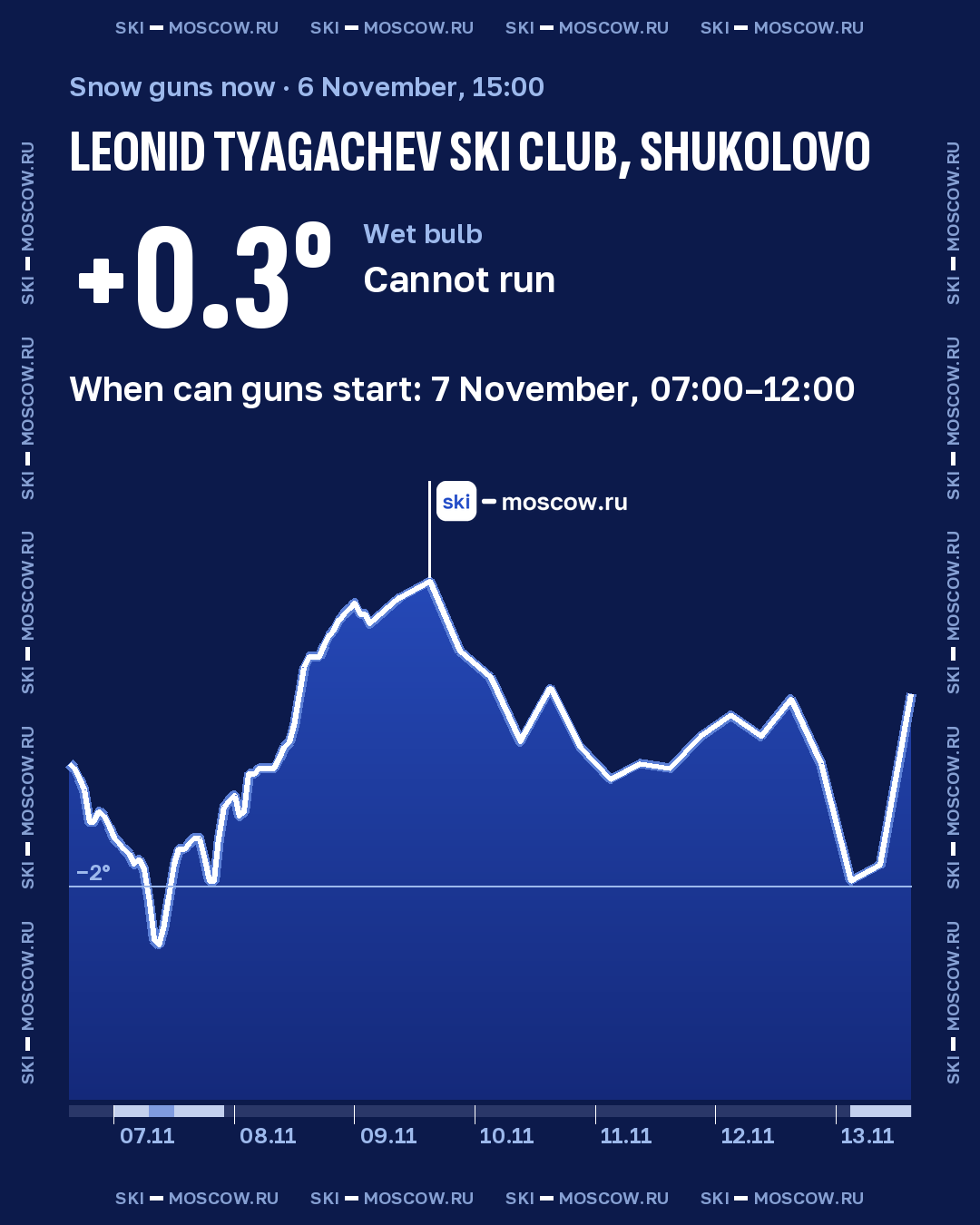
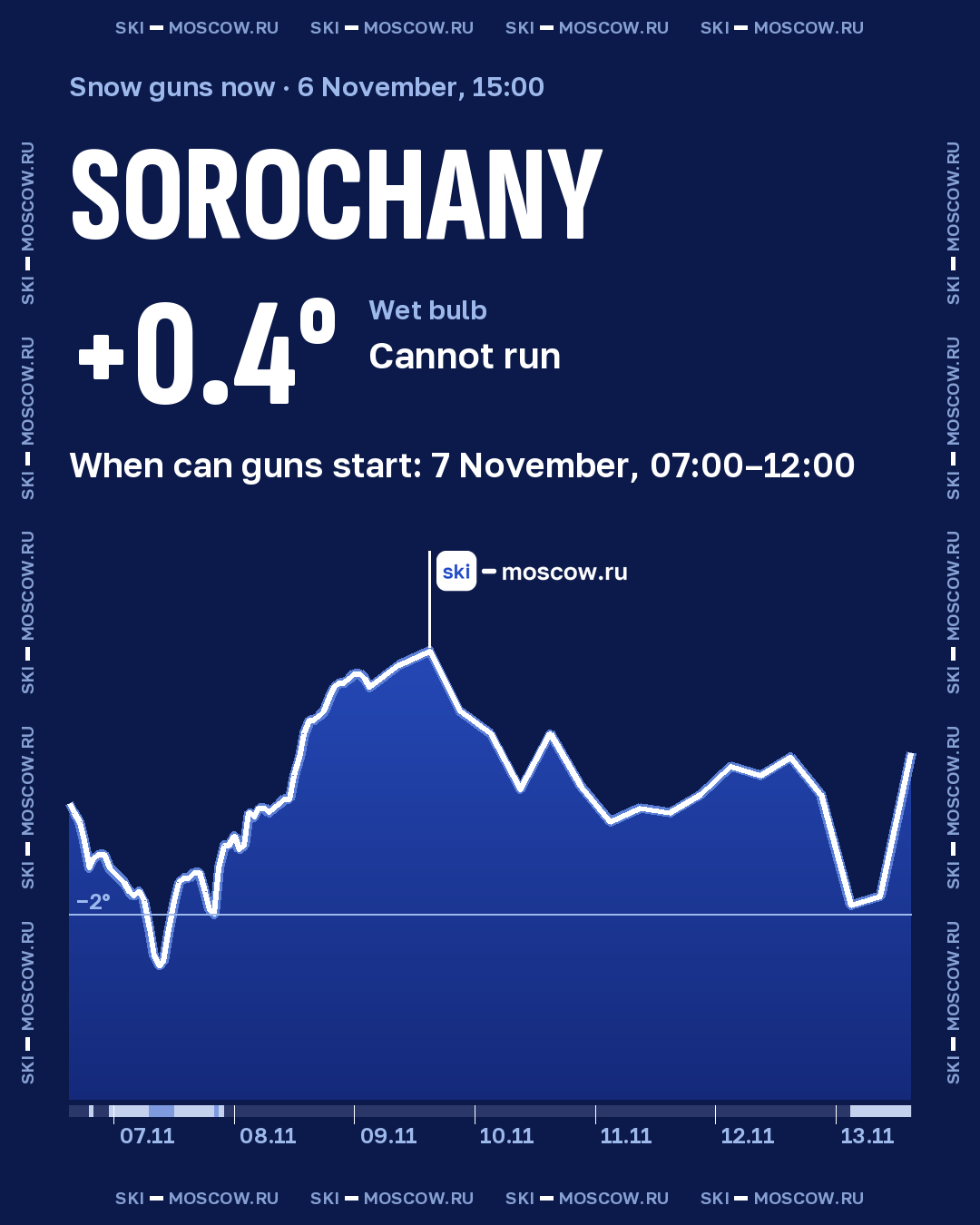
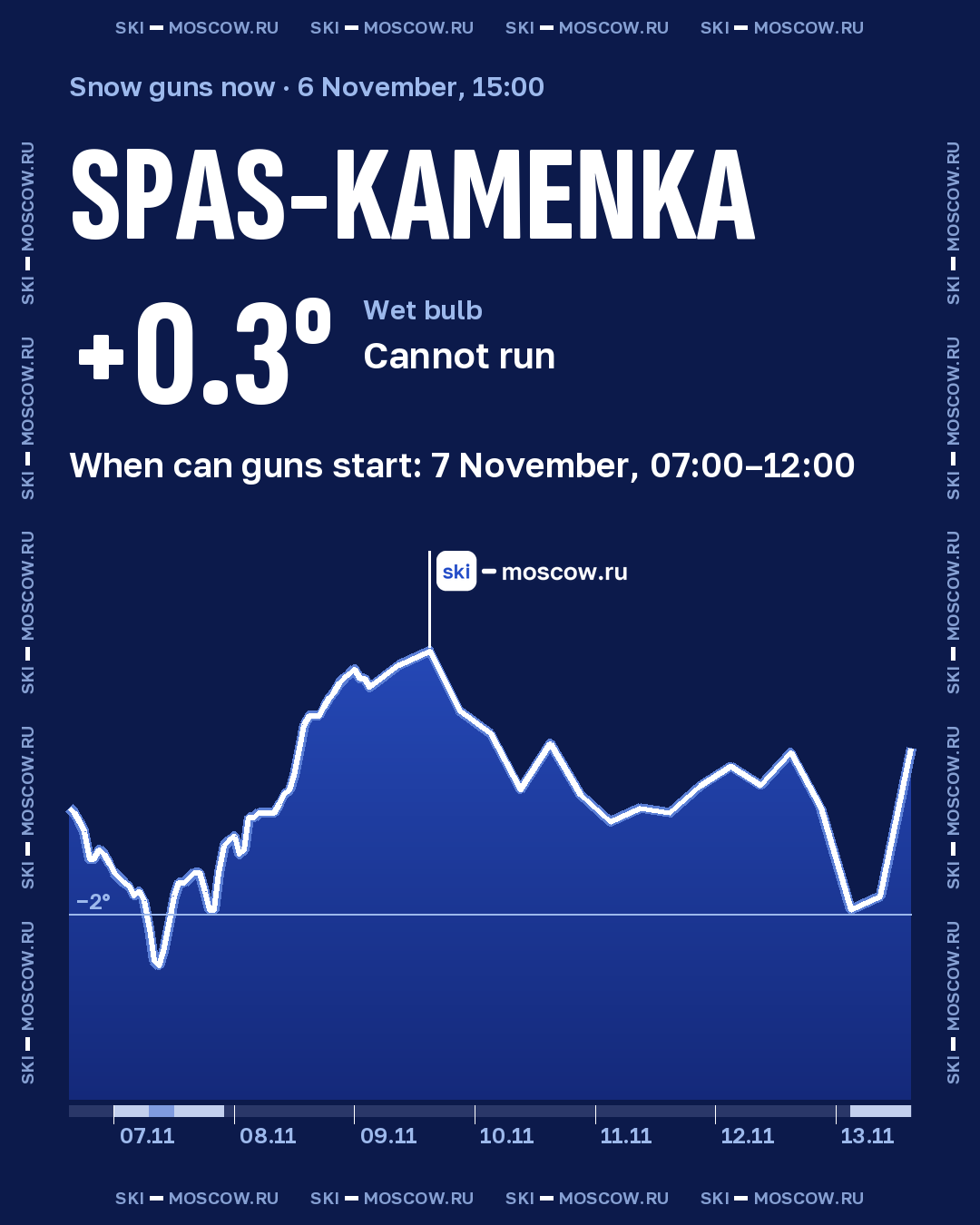
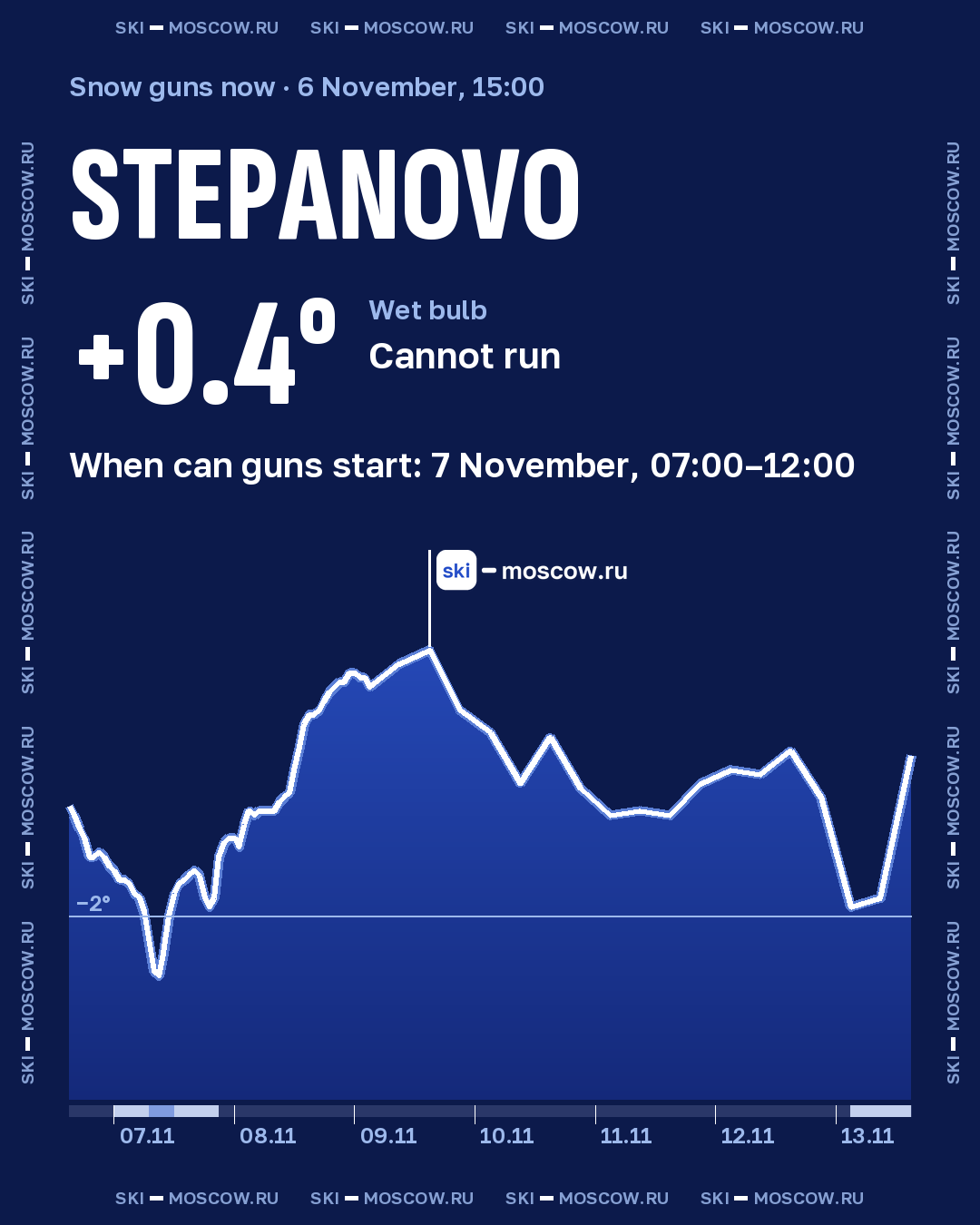
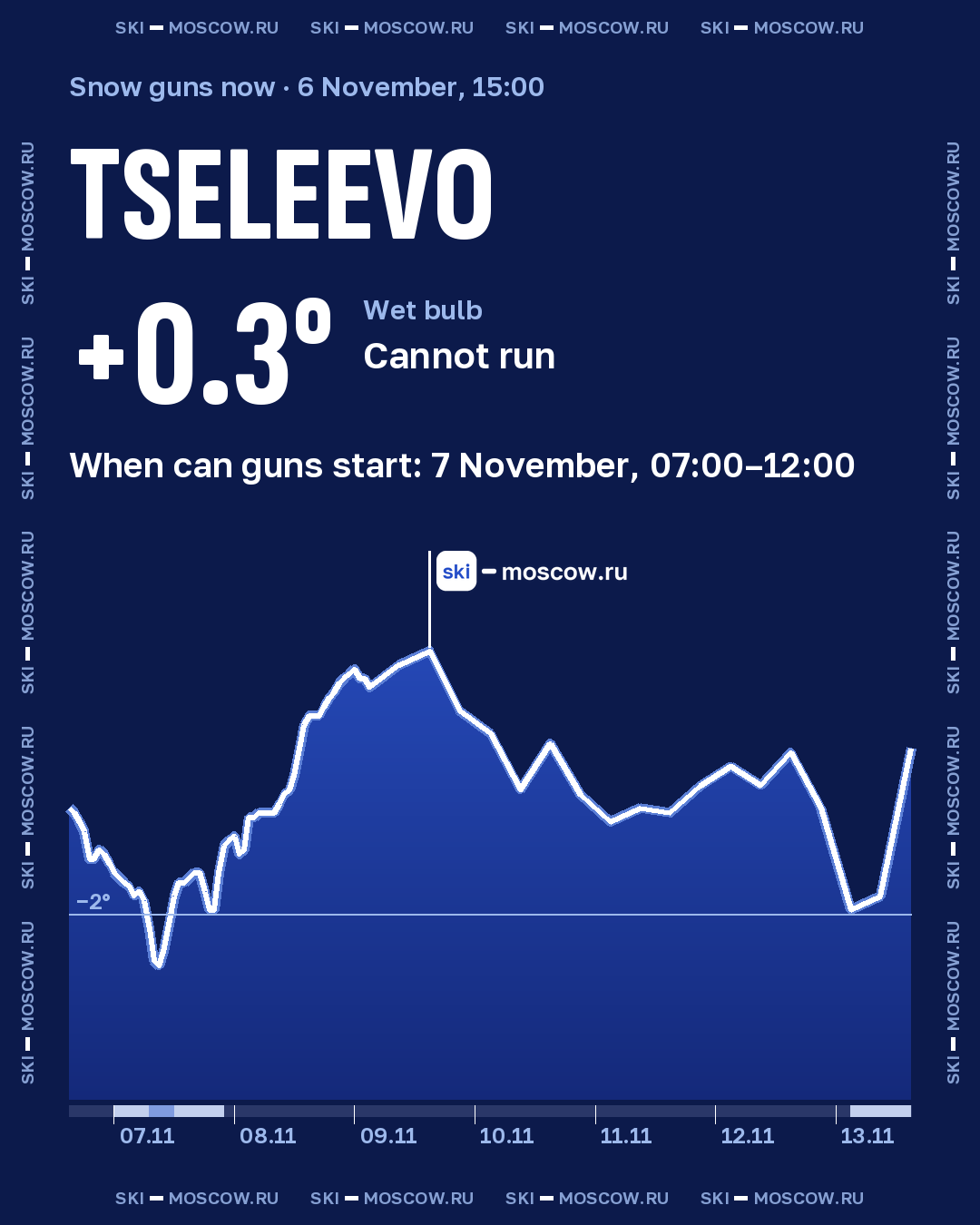
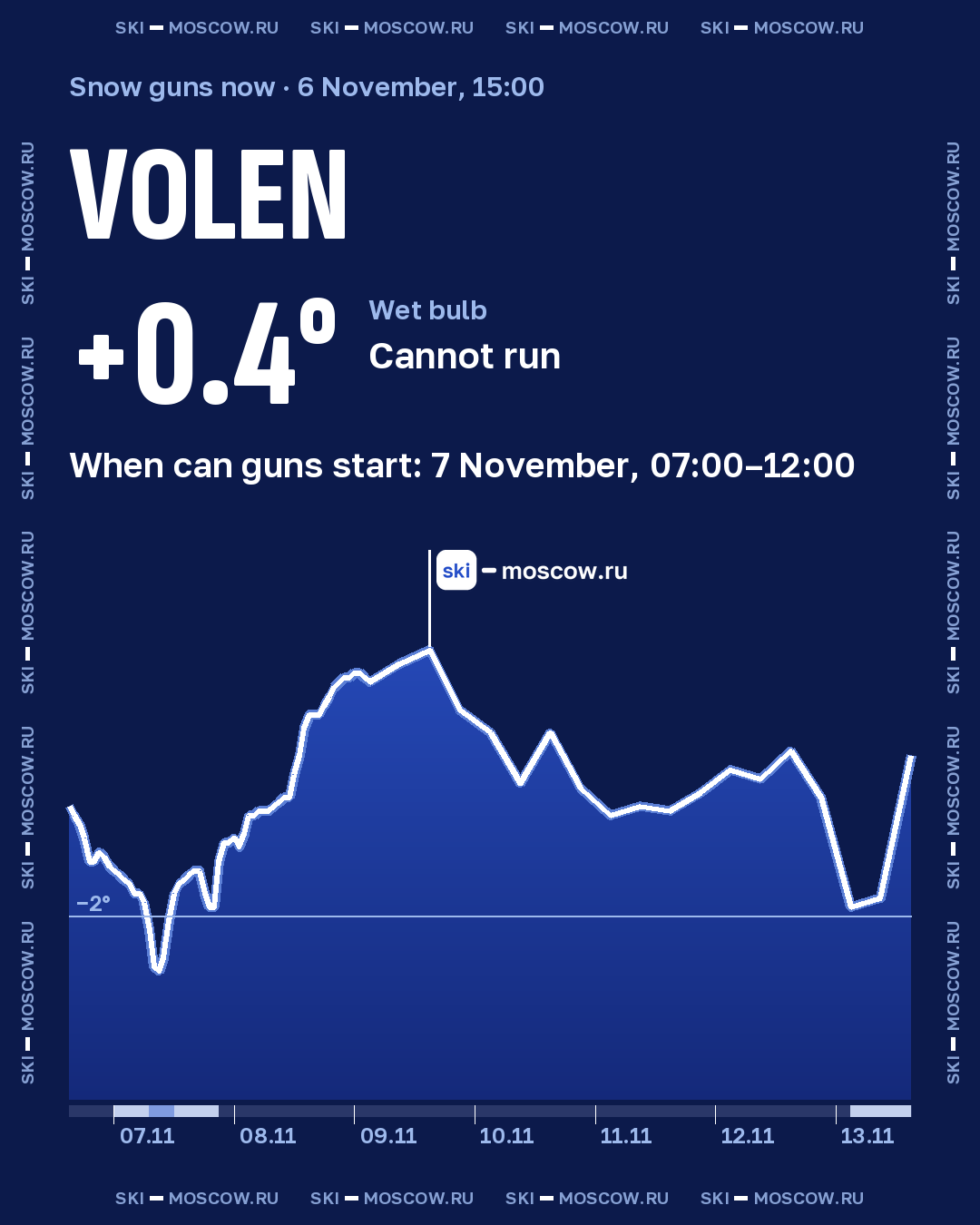
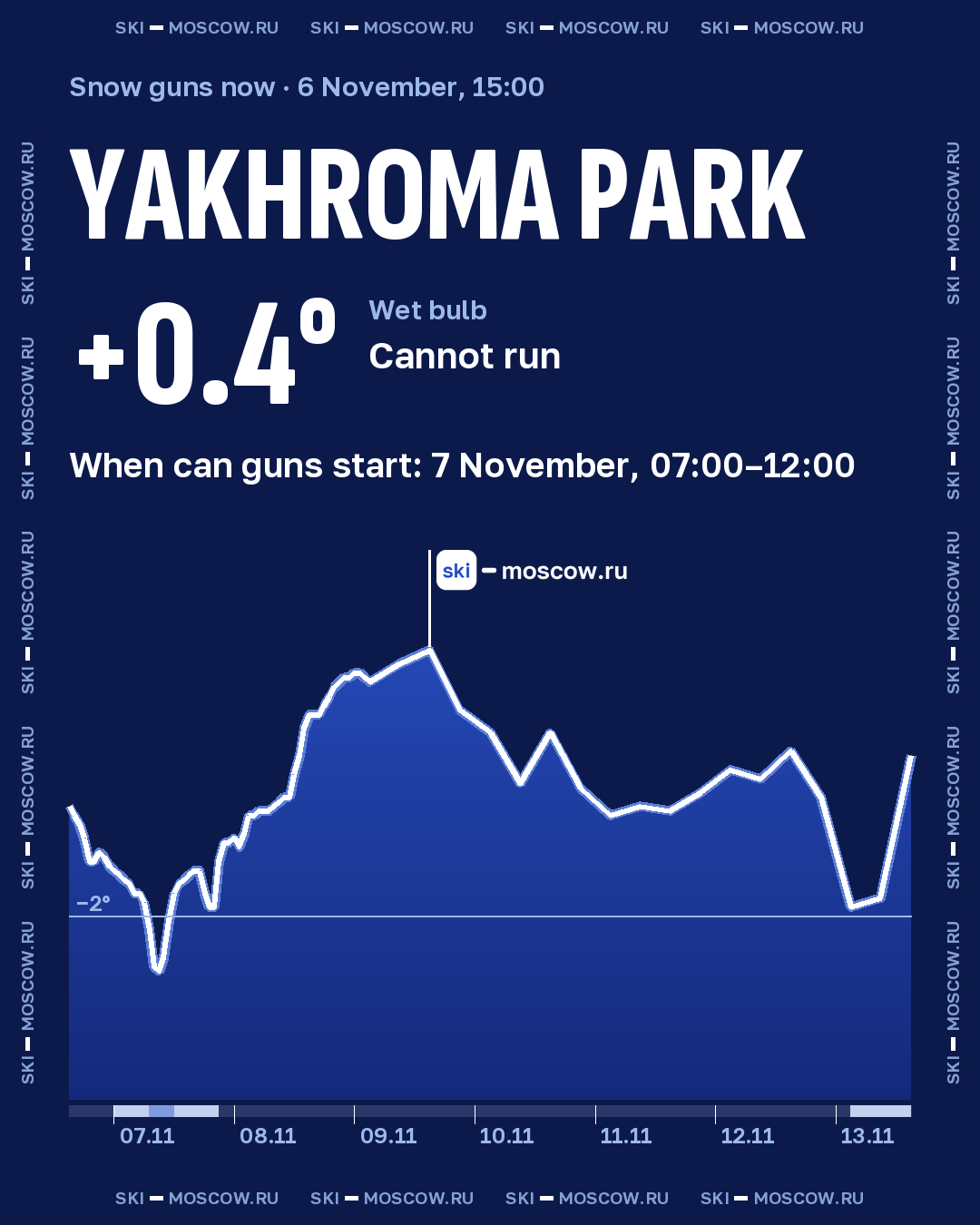
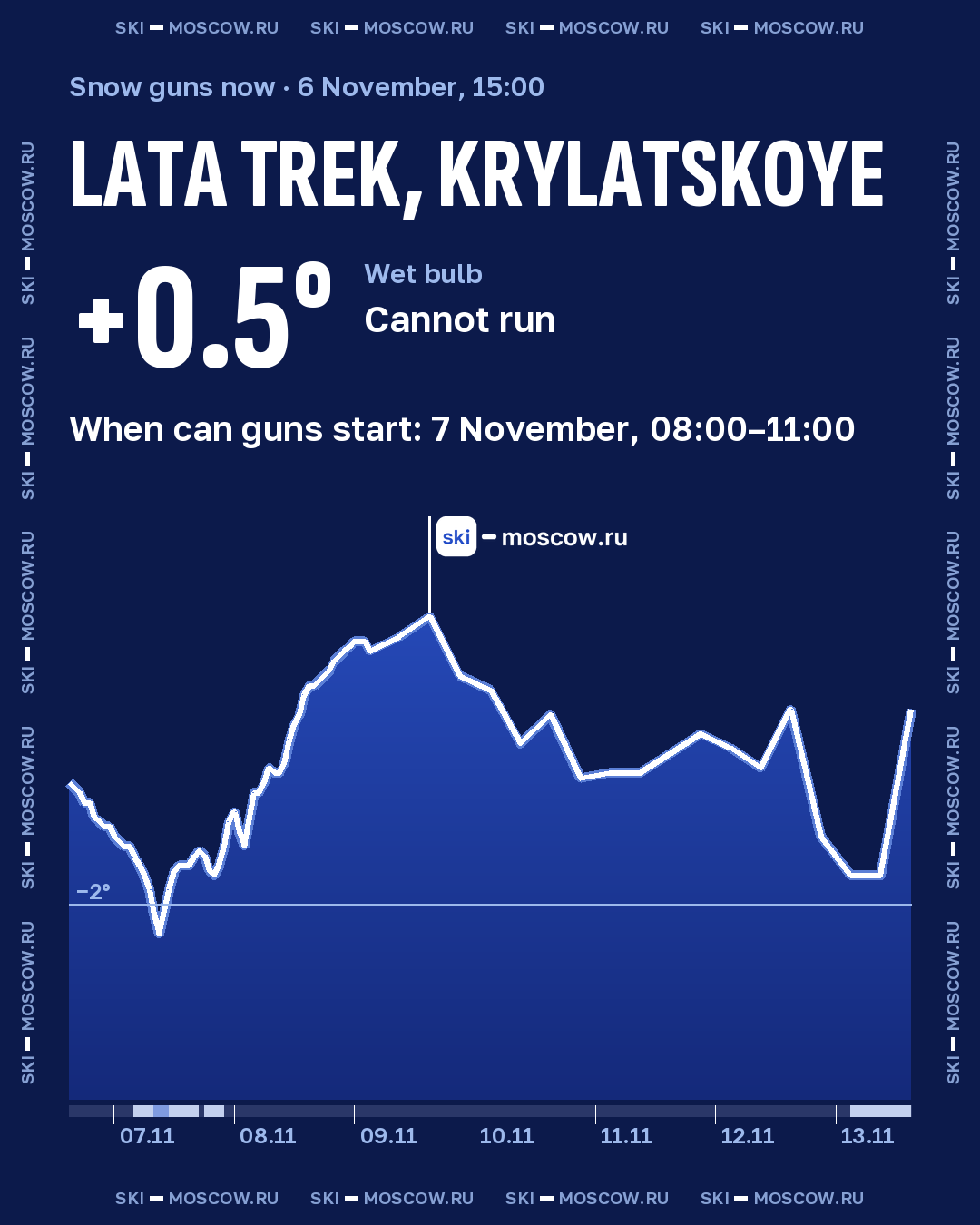
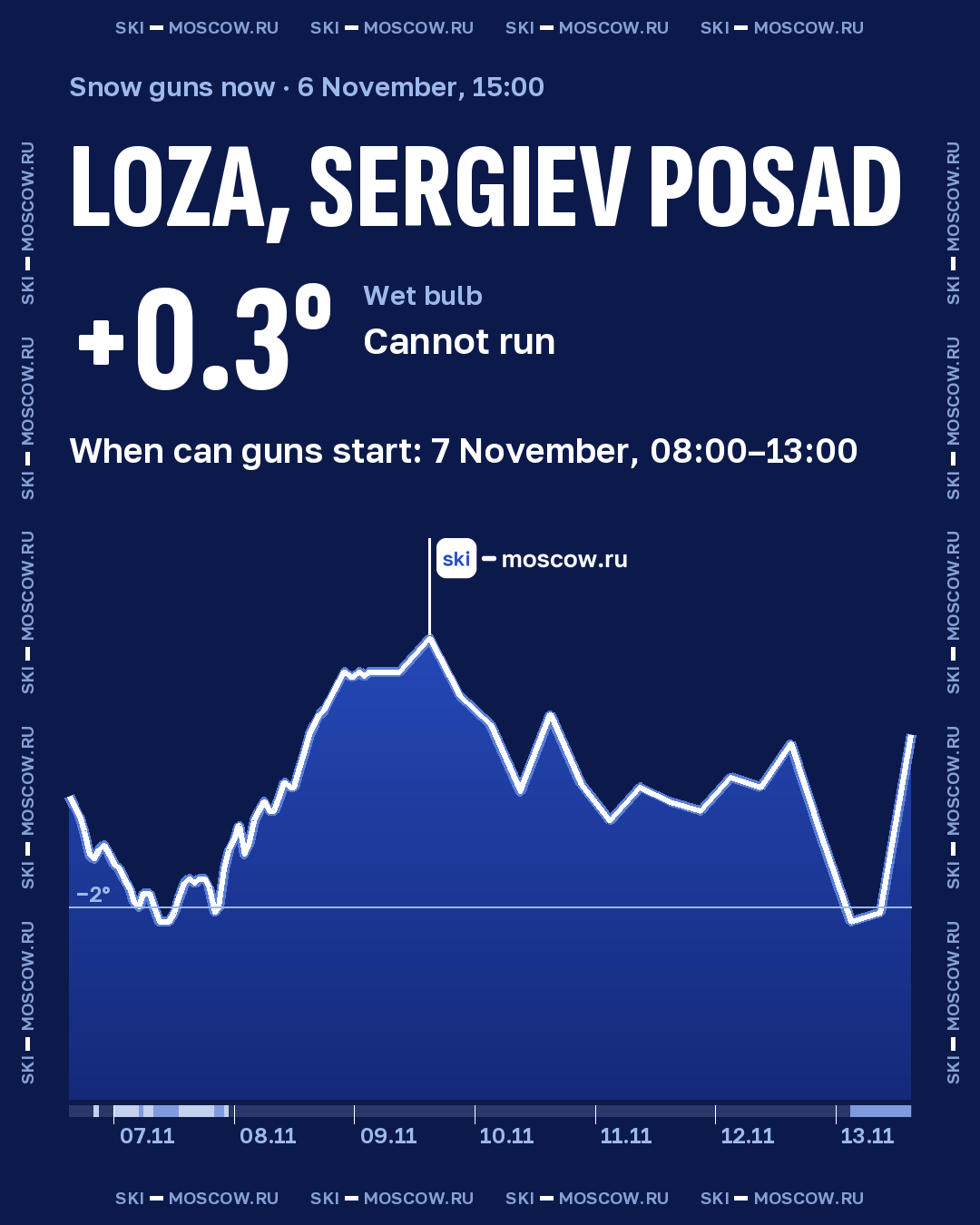
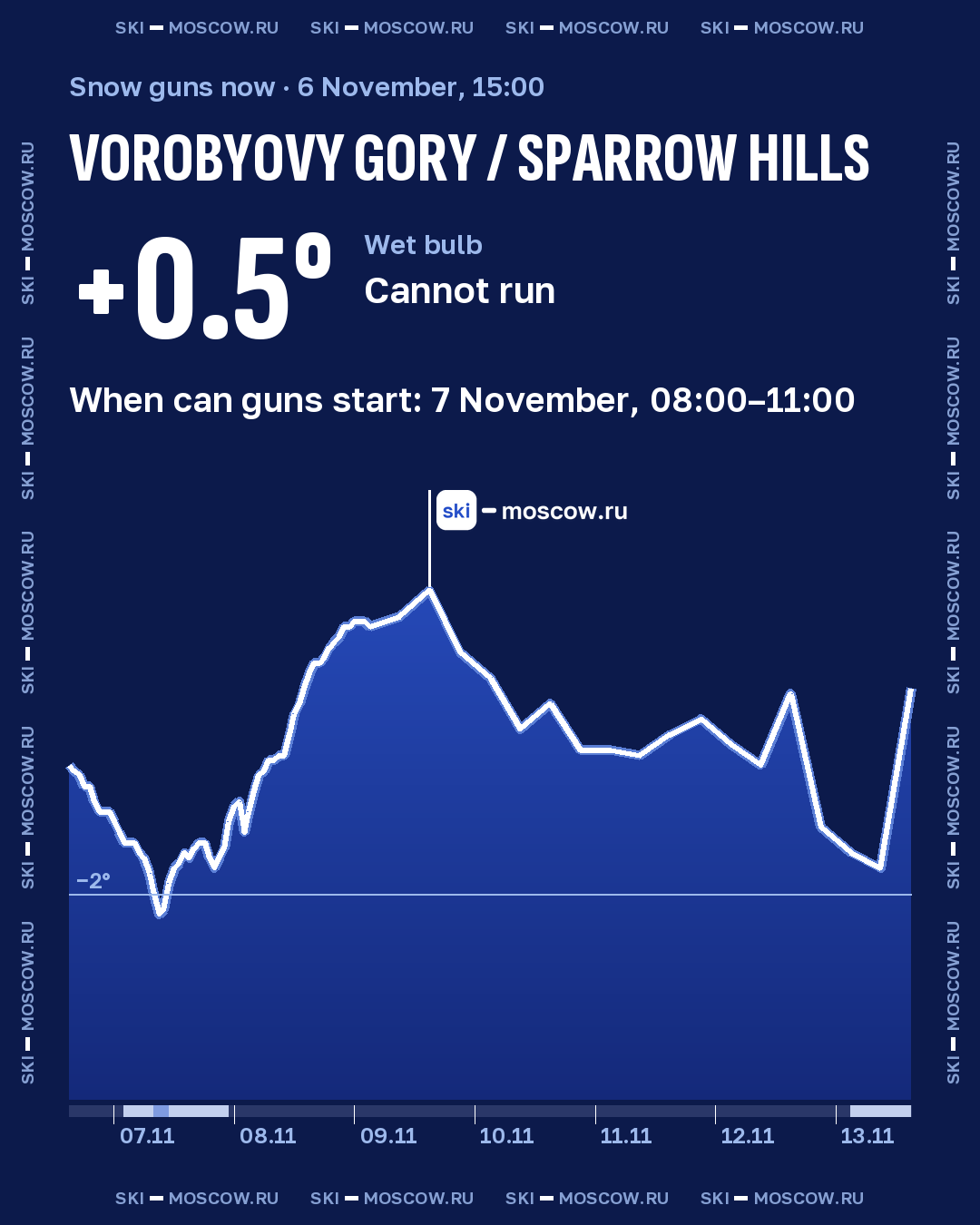
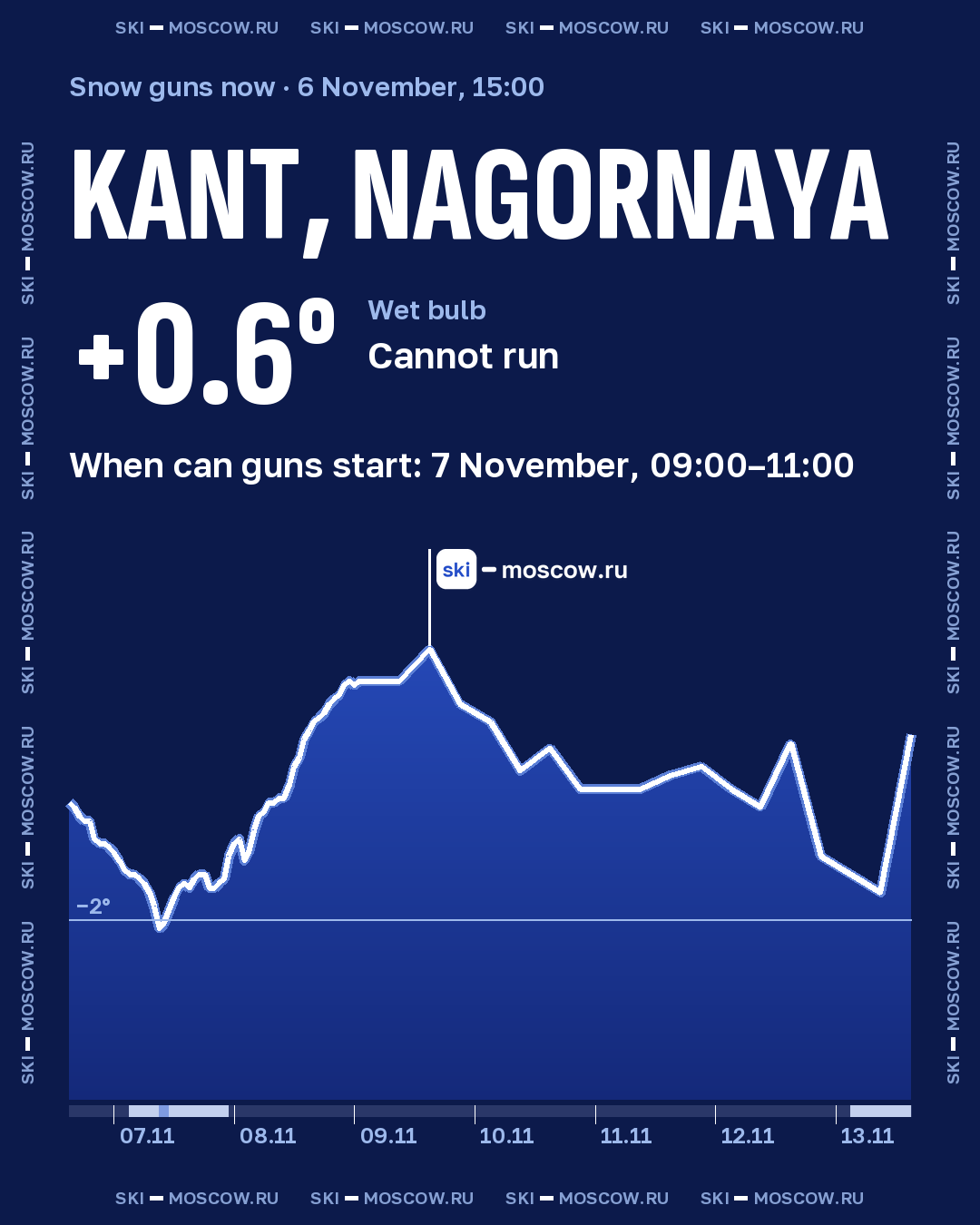
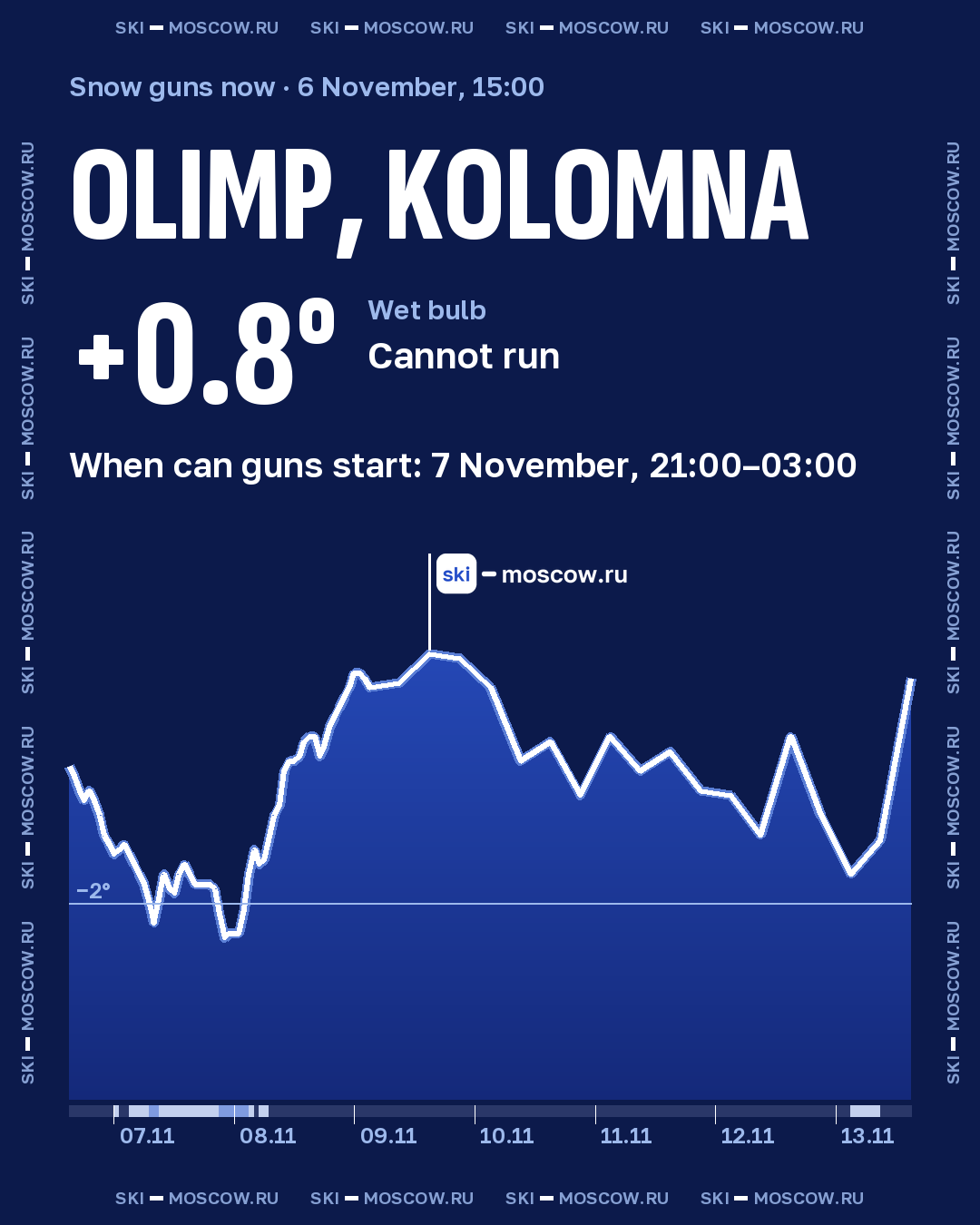
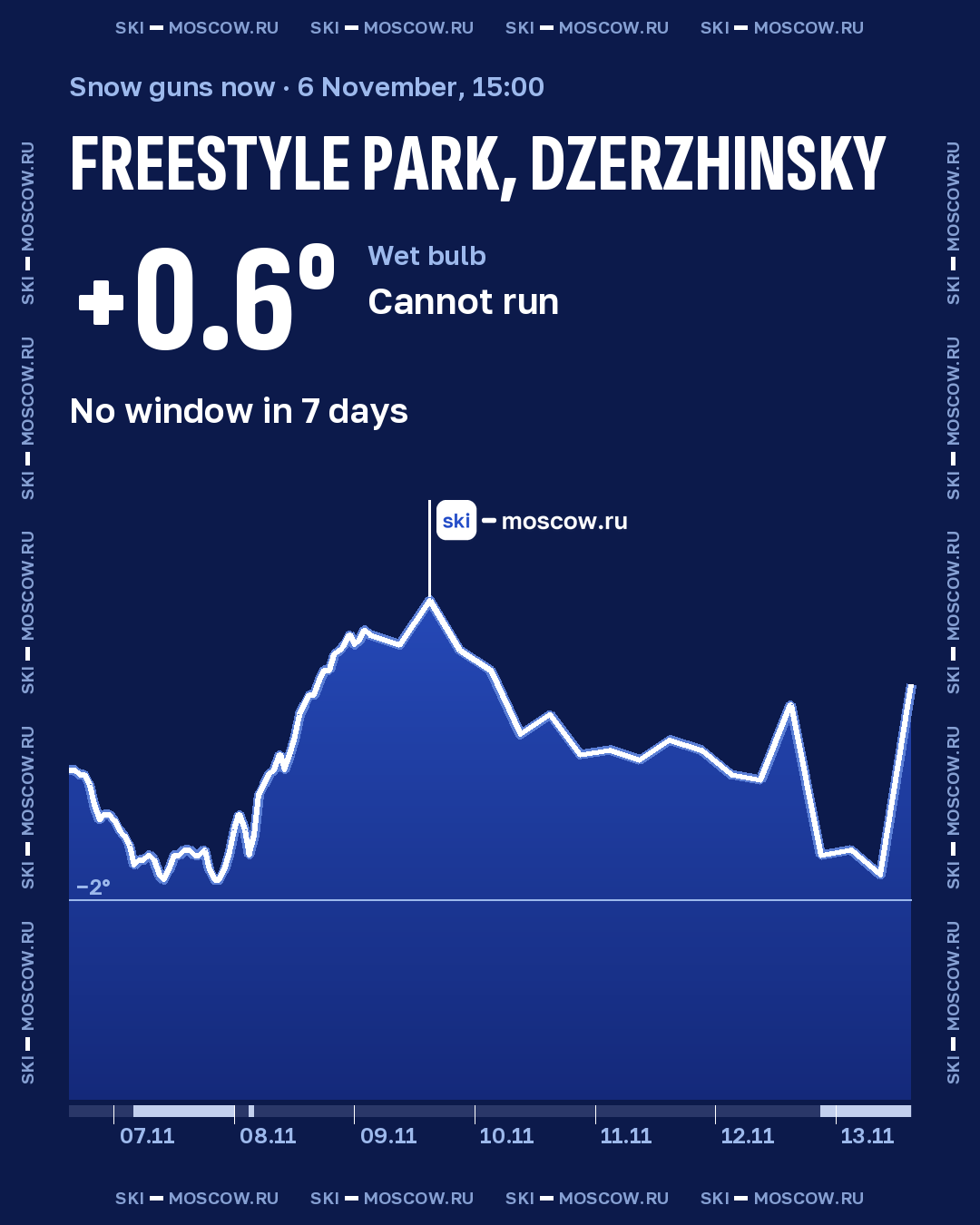
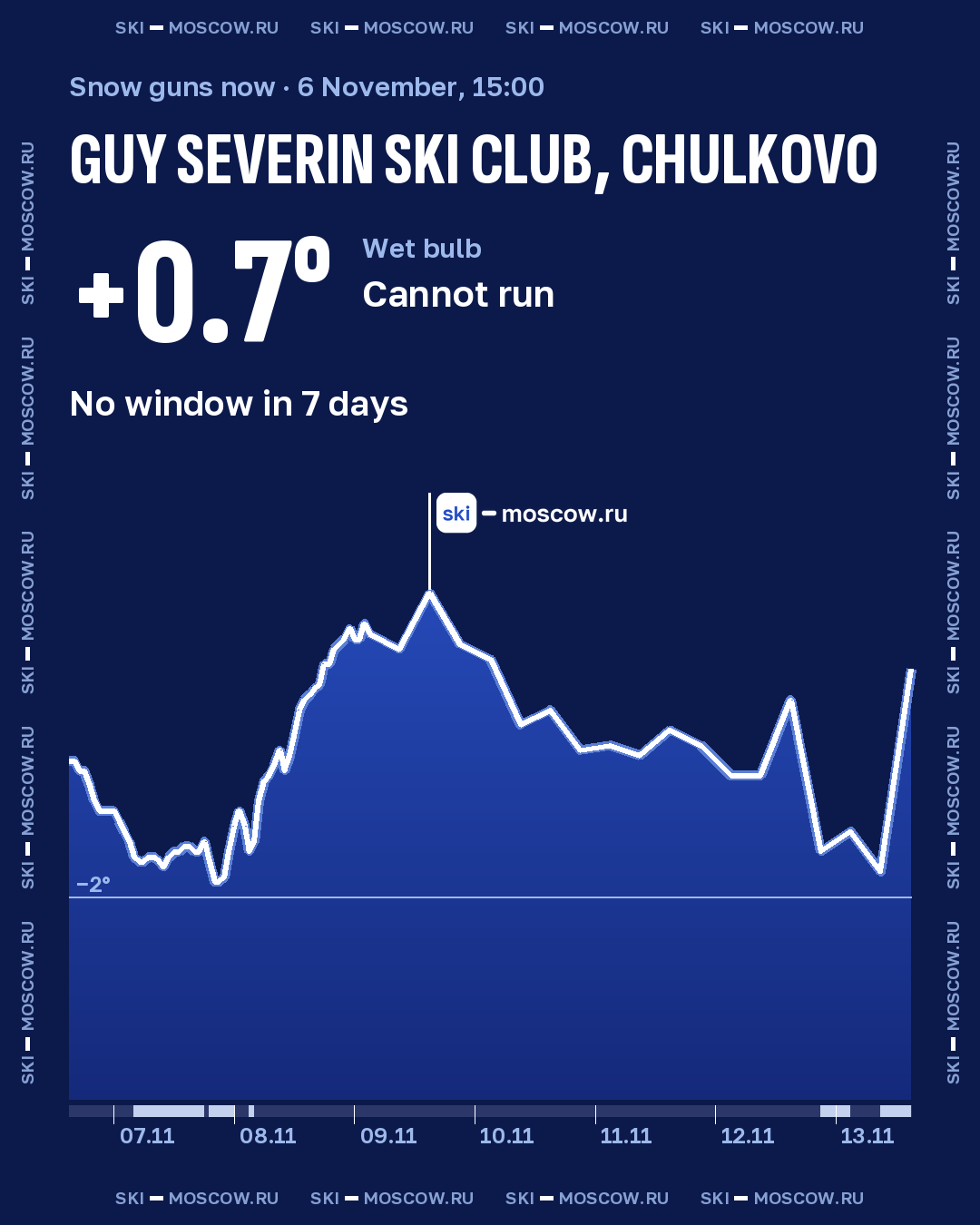
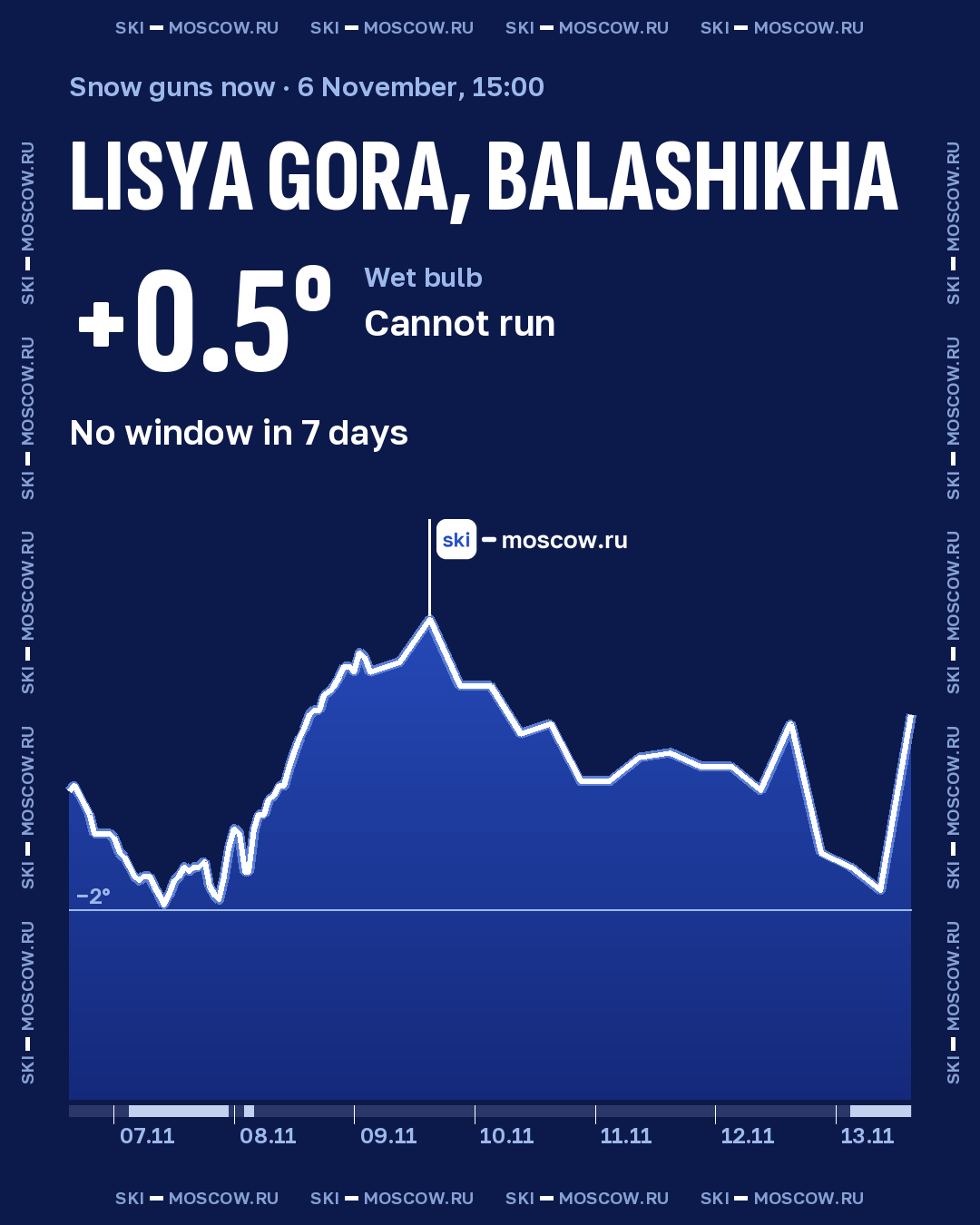
Getting ready, no date yet. The operator promises the date soon. Snowmaking was upgraded, runs widened and beginner run 13 extended to 600 m. Last season opened on 26 December.
This shows what the weather allows, not whether guns are running. Operators decide by water, power and schedule.
Gun calculator
Enter the gun and the weather. The box shows how much snow it lays per hour and per night, and at what wind.
An estimate for planning, not a manufacturer’s figure. The gun’s own chart beats this calculator. Assumptions are listed below.
How a gun makes snow
Cooling tower chills the water
Water under pressure
Nucleators: ice seeds
Nozzles: fine droplets
Fan throws the plume
Drops freeze in flight
Hours for guns over ten winters
40Oct
280Nov
489Dec
580Jan
532Feb
346Mar
−2°
−4°
−7°
Average hours per month at or below each wet-bulb limit, Dmitrov district, winters 2016/17 to 2025/26. ERA5 reanalysis through Open-Meteo, computed by us.
Winter
First 24 h in a row
Hours Nov–Dec
2016/17
31 October 2016
1055
2017/18
26 October 2017
602
2018/19
30 October 2018
1024
2019/20
31 October 2019
420
2020/21
17 November 2020
755
2021/22
10 November 2021
828
2022/23
15 November 2022
1036
2023/24
25 October 2023
885
2024/25
6 November 2024
725
2025/26
16 November 2025
361
Formulas and assumptions
Wet bulb: psychrometric equation solved by bisection with Magnus saturation pressure, sea-level pressure from the forecast.
Snow = water × (1 − losses) × 1000 / density. Water = top flow × min(flow share, √(p / p top)).
Losses: 30 % + 2 × air °C, kept to 7–35 % as in Davos; 6 points less for fan guns; plus 1.5 points per m/s above 2 m/s. The last two are our assumptions.
Wind limits, our assumption: fan guns drift above 6 m/s, stop above 10; lances drift above 4, stop above 7. Operators report trouble from gusts of about 9 m/s; lances are more sensitive. Drift = wind × flight time, 5 s for fans, 7 s for lances.
Water temperature: TechnoAlpin’s rule of thumb is that 4 °C colder water equals 1 °C colder wet bulb. The calculator counts from 2 °C water; the forecast tables do not use it.
Cooling towers: a tower cools water towards the wet bulb and never below it, so it works best on the same dry cold nights as the guns. TechnoAlpin gives 30–90 l/s of flow at 15–45 kW depending on the model. Enter the water temperature after the tower in the calculator.
Chance: normal spread around the forecast, 1 °C now plus .35 °C per day. MET Norway gives no spread for this area, so this is our assumption, not a model output.
Reference guns where the make is unknown: fan 640 l/min, lance 120 l/min.
TechnoAlpin does not publish top flow in these sources: 757 l/min comes from a SAM figure for the TF10, TR9 is scaled by nozzle count.
Why a gun looks at the wet bulb, not the thermometer
A droplet from a gun loses heat by evaporating, and dry air takes more of it. At −1 °C and 70 % humidity the wet bulb is −2.6°, enough to start. At the same −1 °C and 97 % it is −1.2°, and the gun stays off. Air temperature alone cannot tell the two nights apart.
Makers name a start between −0.5 and −2.5 °C wet bulb, but at the start a gun passes only a trickle: the MND Peak Plus runs from 50 of 640 l/min. A Russian maker writes that near −4 °C a gun gives at most 20–30 % of its top output. That is why this page treats −2 °C as the working line and shows the percent.
Not all water reaches the run. In twelve field tests near Davos, 7–35 % of it was lost, 21 % on average, and losses grew with air temperature. The snow that landed weighed 442 kg/m³ on average. So one cubic metre of water gives roughly two cubic metres of snow: the Krasnaya Gorka complex reports 40 m³ of water to 80 m³ of snow per machine, TechnoAlpin quotes 2.5.
How many gun hours a Moscow winter gives
Over ten winters the Dmitrov district averaged 280 hours at −2 °C wet bulb or colder in November and 489 in December, but the spread is wide: 361 hours for November and December together in 2025/26, 1055 in 2016/17. The first full day below the line came between 25 October and 17 November. Central Moscow differs little: 264 November hours.
TechnoAlpin counts about 1,000 m³ of water for a 30 cm base on one hectare. By our estimate one fan gun at −7 °C wet bulb and a light wind passes 23.8 m³ an hour, so that base takes 40 gun hours. Four guns would need about 10 hours: four nights of 12 hours fit an ordinary December, but only just a warm one like 2025/26.
Fleets differ. By operators’ forms Volen and Stepanovo together report 17 guns and 49 lances with 9 more planned, Sorochany 36 machines, the Tyagachev club 16, Freestyle 12 guns and 3 lances, Kant 12. Even so, in January 2025 Volen had snowmaking capacity for about half of its 14 runs: pumps, water and cold hours limit a slope before the number of guns does.
Public tenders give a price scale. Moscow’s Yauza Park tendered a fan snow machine with a built-in pump at a starting price of 6.05 million roubles in December 2025, a Moscow district office tendered a pump station with snow machines at 18.8 million in October 2026, and Mari El tendered one snow machine at 7.3 million in March 2026. Those are starting prices, not contract totals.
Questions
When are snow guns turned on?
When the wet bulb falls to about −2 °C, usually at night. In the Dmitrov district the first full day below that line came between 25 October and 17 November over ten winters, and November averages 280 such hours.
At what temperature do snow guns work?
Makers name a start from −0.5 to −2.5 °C wet bulb and air no warmer than +2 °C. In practice a gun works noticeably from −4 °C wet bulb, and by our estimate reaches top flow near −12 °C.
How much snow does one gun make per hour?
By our estimate a fan gun with a 640 l/min top flow gives about 20 m³ an hour at −4 °C wet bulb, 48 m³ at −7 °C and 95 m³ at −12 °C. Makers quote up to 72–120 m³ an hour for ideal conditions.
How much water does snowmaking use?
One cubic metre of water gives about two to two and a half of snow. TechnoAlpin counts about 1,000 m³ of water for a 30 cm base on a hectare.
Can snow be made at 0 °C?
Yes, if the air is dry: at 0 °C and 30 % humidity the wet bulb is −4.1°. In damp weather no, whatever the thermometer says.
Does a cold night mean the slope is open?
No. This page shows what weather allows, not what an operator did. Check the season page and the operator.
What does a gun at 30 % mean?
It can take about a third of its top water flow without producing slush, so it makes about a third of the water into snow per hour compared with a very cold night.